


I have been reading with great interest, a couple of articles by Adam Cz titled “Roller Derby is Boring (but we can do something about it)” [ Part 1 | Part 2 ]. One of the main issues that is discussed are “blowout” scores, such as one team scoring 300 and the other scoring 40. I do agree, these types of games do make for a predictable ending even 10 minutes into the first period. The article series tends to put the blame on the lead jammer rule. I disagree.
Blowouts have been happening since the modern resurgence began in the 00s, however they have not been as frequent as they are today. If we were to consider a “blowout” as a game where 90 percent of all of the points scored went to one team and we did not count games that took major departures from the rules at the time (such as mini-bouts and events like “one 30-minute jam”), the first recorded blowout in Arizona would have taken place on June 21, 2008 in a Tucson Roller Derby home team bout where VICE Squad would topple Iron Curtain 164~14. Keep in mind, the first recorded bout in Arizona was played on November 22, 2003 and that was before there were any real rules (and even in that game, Arizona Roller Derby’s Smash Squad would beat the Bruisers 64~48).
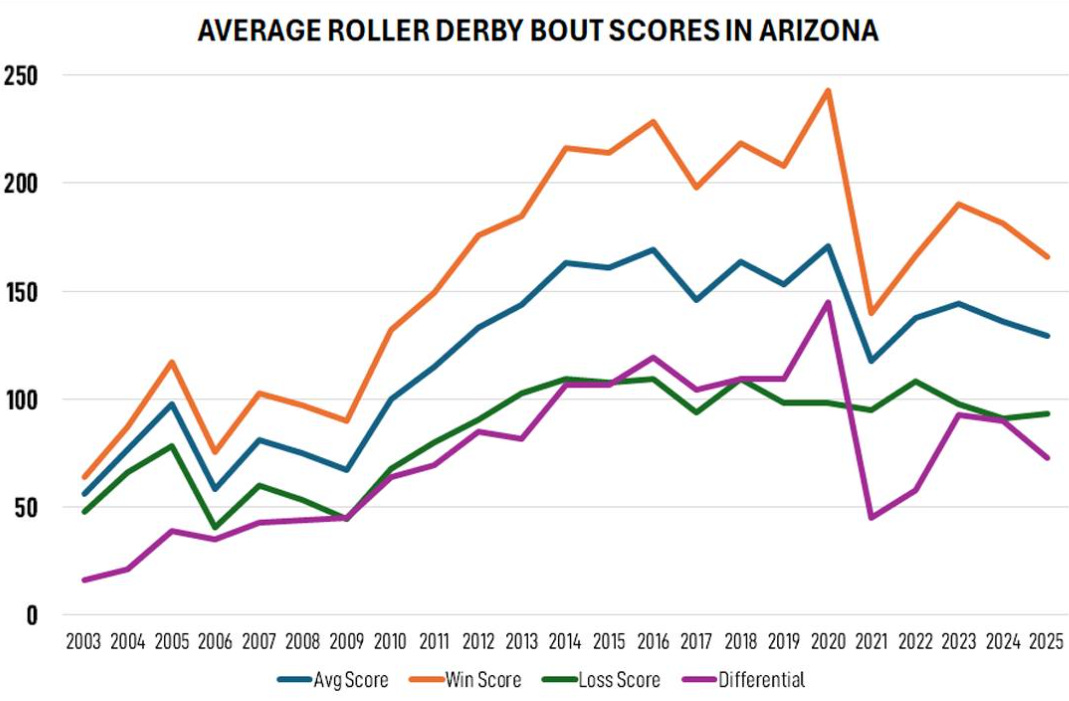
This graphic was based on the scores of all games recorded in Michi-chan Sports’ DerbyData which encompasses about 75% of all roller derby bouts/games played in Arizona or involving an Arizona team and includes all rulesets (the WFTDA rules at the time, USARS, AZDD/DDRD house rules, Renegade scoring, etc.).
The sharp increase starts to take place as we go into 2013. This was the time when derby started to experiment with what we call “modern strategy”. This includes the “tripod” style defense and other methods that transformed the sport from a jammer’s game to a blocker’s game. This was also the time when we saw the loss of the two whistle start in WFTDA and we saw changes to the rules that allowed packs to slow down, move in reverse motions and move right up to the jammer line before the whistle blew to start a jam. In the old days, blockers in the pack were more spread out within the pack and yes, we had our share of “20 foot rule” yieldings in the day. The pack would actually try to help their jammers through with whips and pushes. Seeing a star pass in a game was a rare treat where today it is much more common, especially in banked track.
The modern strategy where packs become brick walls as opposed to mere obstructions to the jammers would eventually drive the average winning score to be over 200 in mid-2013. The first >200 game that was recorded in DerbyData was on October 2, 2009 at Derby On The Rocks when Rocky Mtn. defeated the Tucson Roller Derby Saddletramps 27~319, a blowout win. The first non-blowout (>90%) game would be on February 26, 2010 at the Wild West Showdown where Rat City would defeat the Saddletramps 270~55.
If you look at some rulesets, such as USARS, the average scores are considerably lower, mainly because the packs are still expected to move.
So, should WFTDA completely roll back the game to the days of ruleset 3.1 in 2009, bring back in the two-whistle start and the jammerless jam? If you were to ask me this a few years ago, I would have said absolutely. But despite my past frustrations with “modern strategy”, the modern game does have some great qualities even though the modern WFTDA game is nearly a complete departure from what was once “roller derby”, especially for those of us old enough to have fond memories of the pre-resurgence banked track days (I don’t mean David Sams and his alligators).
Perhaps, the issue is not the strategies used in the game. Perhaps, the issue is the scoring format. The format currently allows games to run away with no chance of narrowing up. Let’s face it, lead changes are fun (hydrate!!). They keep the crowd excited, but without rolling the game back to 3.1, I don’t see much of an easy way to reduce blowouts with the traditional scoring methods.
I would like to introduce two scoring formats that we have been working on here at Michi-chan’s Derby Labs to help improve the fan experience and using one method, making the game more attractive for linear television. These methods are based on other sports that I follow. So, please indulge me as I present these ideas. You may totally hate these, but I just want to say, there is another way to do this.

Cricket style scoring
Cricket is played around the world, mainly in the commonwealth nations and has some similarities to American baseball. Only one team scores at a time. In cricket, the game begins with a coin toss and then the winner of the toss decides whether they want to bat first or second. We will use the rules for a popular format of cricket called “T-20”. In T-20 the “innings” (half) consists of 20 “overs” with 6 balls delivered per over. If the ball hits the “stumps” (those 3 vertical sticks behind the batter) either when being bowled (pitched) at or while running and being “out of the crease”, that is a “wicket”, which is the equivalent of an out. If 10 wickets take place before 20 overs are completed, then that team is finished batting. When the second team comes up to bat, their objective is to “chase” the first team’s score and try to beat it by at least one. If they are not able to beat the score within 20 overs or after accumulating 10 wickets, then the game is over and the first team wins the match.
With that let’s think about a format like that for derby:
Only one jammer is fielded thus making every jam a power jam. No need for a lead jammer. The offensive team will field 5 skaters with one designated as the jammer and the other as a pivot. The defensive team will field 4 skaters consisting of 3 blockers and a pivot.
A coin toss will be used to decide which team will jam first (the winner of the coin toss will make that decision).
Each jam will be 2 minutes (WFTDA) and can only be called off when the jammer commits a penalty.
Traditional derby scoring is used.
A period would consist of 15 2-minute jams.
Penalties on blockers and the pivot will be enforced the way they are today.
Penalties on the jammer will be enforced at the time of occurrence and will result in a stoppage of play and still counts towards the 15 jams per period. If a team accumulates 5 jammer penalties, the period for that team is over and whatever score they have will be their game score (think of it like getting 10 wickets in cricket). If there is a penalty on the jammer, the offensive team will skate short one blocker for the next jam.
Once the first team finishes, the second team will try to “chase” the score with attempts on 15 jams. The second team wins as long as they can beat the first team’s accumulated score within the 15 jams and without racking up 5 jammer penalties.
If the game is tied after the final jam, the game reverts to traditional roller derby where both teams will field a jammer, a pivot and 3 blockers. Traditional overtime jams are played until there is a winner.
Of course, no one has ever played a game like that in a public environment so we do not have any stats. But this is a concept that can be experimented with.
Banana Ball Scoring
Banana Ball is a modified version of baseball that involves a significant entertainment component and a modified rule set. When founder Jesse Cole developed Banana Ball, he was looking at all of the things that made traditional baseball “boring” and he wanted to create a game that allowed for more fan engagement. Some of the new rules included:
No bunting, because bunting sucks.
Games are played with a 2 hour time limit. If the clock runs out before the 9th inning starts, the current inning becomes the final inning.
Extra innings are played as “showdowns” where there may be one pitcher, one catcher and one fielder and other variants if the game remains tied.
On ball 4, the ball will go live after all 8 fielders touch the ball. The runner can take more than one base on this “sprint”.
Fans can challenge plays on the field and if they cleanly catch a foul ball, the runner is out.
One of the most important Banana Ball rules is the scoring. The scoring rules were put into place to address blowouts. The basic rule is simple. Each inning is its own competition. The team that scores the most runs in an inning wins the point for that inning. If the inning is a push (they both score the same runs, even if no runs), no point is scored. In the final inning, all runs count as points.
So, what if we were to adapt that kind of scoring format to roller derby? Think of it this way. Each jam is its own competition and the team that passes the most skaters in a particular jam will win a point for the jam. Like Banana Ball, pushes result in no points. In the final jam, we return to traditional scoring and each skater passed after the initial pass/trip, will count as a point. In the event of a tie, an overtime jam can be skated similar to the existing overtime rules.
Unlike the cricket method mentioned earlier, since there is mainly no changes to how the game is played, any game’s score can be converted into Banana Points as long as you have the points broken down by jam.
Let’s take a look at the March 7, 2026 home team bout at Patuxent Roller Derby which we have jam by jam tracking of. In this game, Salty Beaches beat Kraken Skulls 217~133. But if we want to do a Banana Score, we need to look at each jam:
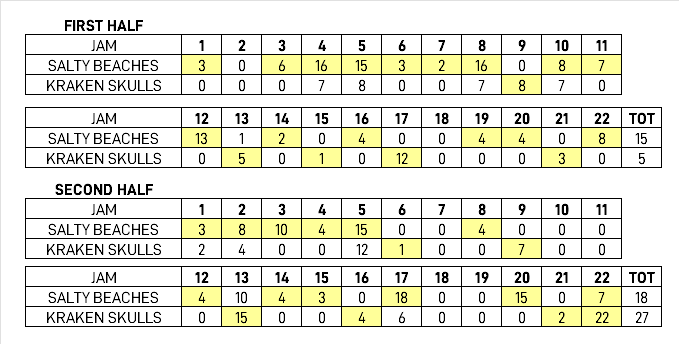
Each jam in yellow is one Banana Point for that team except for the final jam (2P Jam 22) where all points will count. Therefore, in this case, Salty had a great lead going into the final jam with a score of 26~10. In the final jam, Salty picked up 7 points but Kraken picked up a whopping 22. Salty would have still won, but it would have only been by a margin of 1 point.
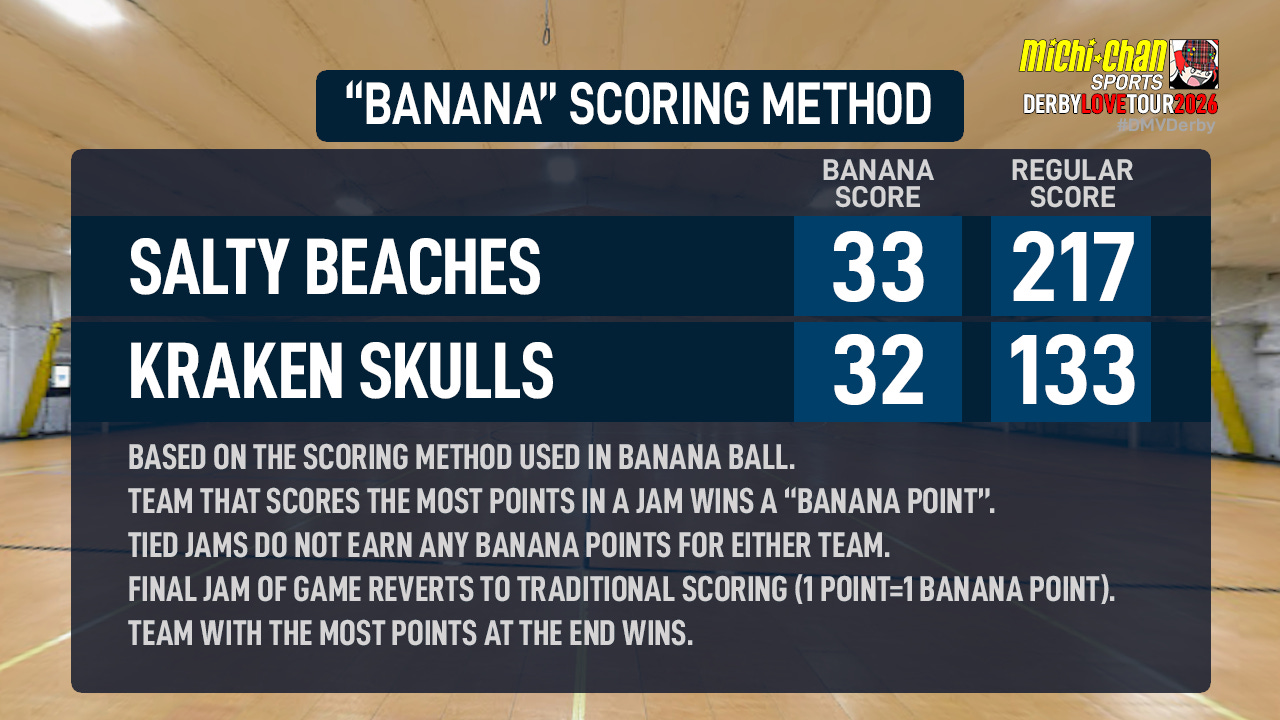
Over the past few months that I have been tracking jam by jam on selected bouts, both flat and banked track, the Banana Score would, in most cases, be the same winner compared to traditional scoring, but there were a few exceptions.
Under this method, a big 20 point jam will carry a lot less weight in the overall outcome. If the other team has had a lot of jams where they were low scoring, but still exceeded the other team on a jam by jam basis, it may be possible that the team with the lower traditional score could win the game if Banana Scoring was used.
I know this is an a pie-in-the-sky concept.. but hey, what do you expect from the Michi?? Always looking outside the box.